SPL on IR2R
over the strongest memory-persistent baseline
IEEE TPAMI 2026 · Memory-persistent embodied intelligence
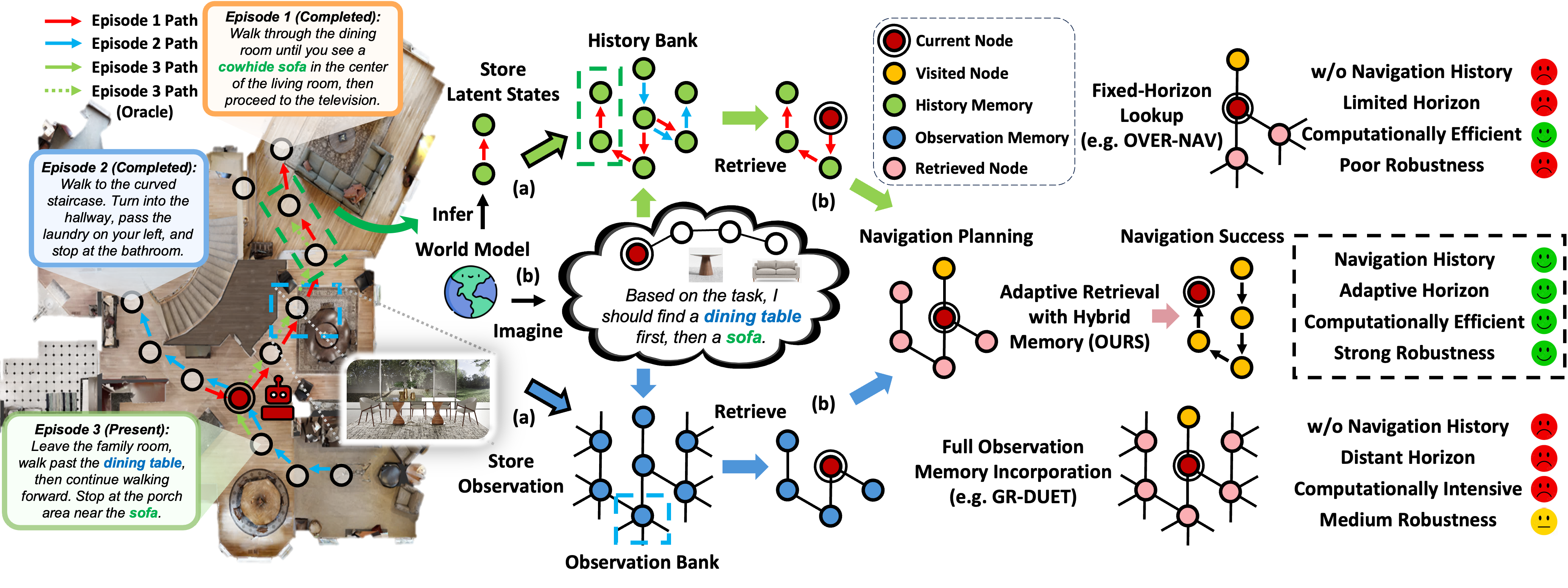
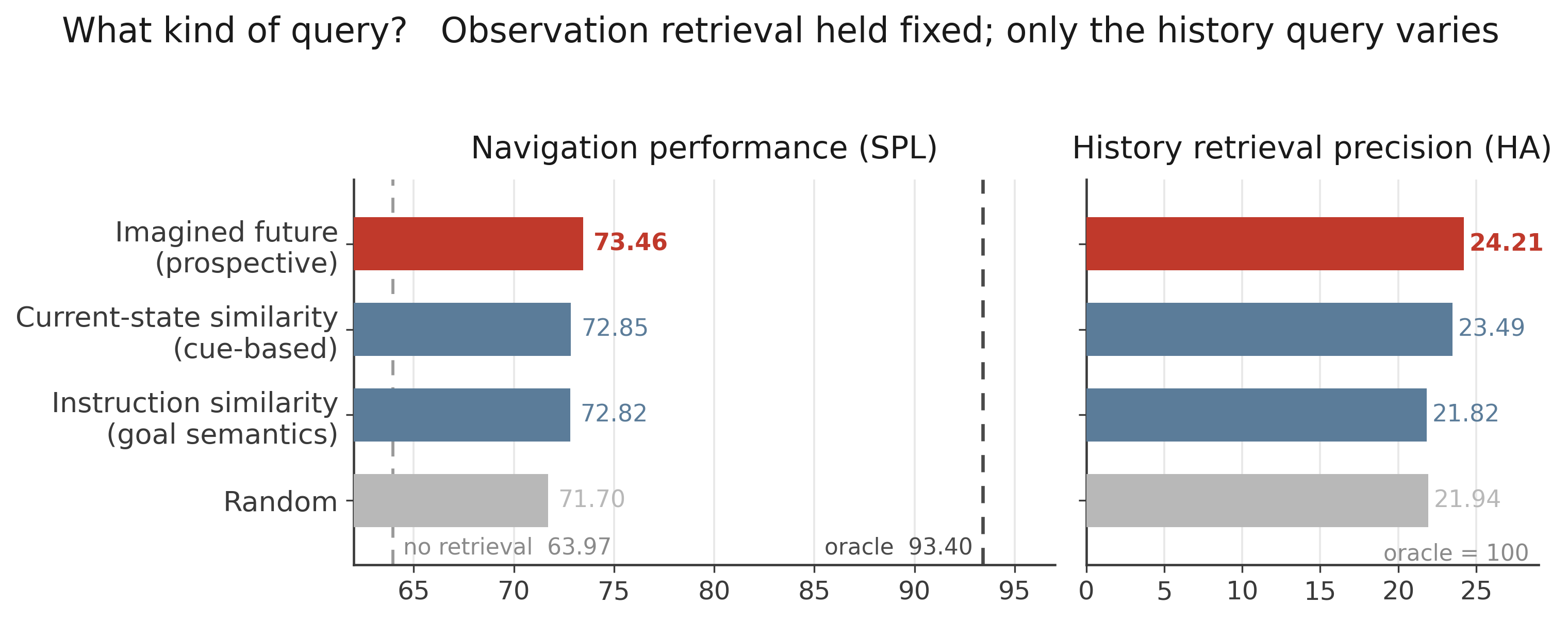
Memoir queries memory with an imagined future rather than the present: a world model simulates where the agent expects to go, and those latent states retrieve the observations and behaviours that match.
Shanghai Jiao Tong University
xyz9911@sjtu.edu.cn PhD expected 2027 · seeking postdoc positions in computational neuroscience and world models

Simulate where you expect to go.
Retrieve what you have seen.
over the strongest memory-persistent baseline
against full-memory incorporation
while improving navigation performance
73.3 achieved vs. 93.4 with perfect retrieval — the open problem
Past navigation becomes useful only when an agent can access the right part of it at the right moment.
Existing systems either absorb the entire memory or inspect a fixed window. Memoir instead learns a language-conditioned world model that imagines task-relevant future states. Those latent states become adaptive queries over an explicit experience store.
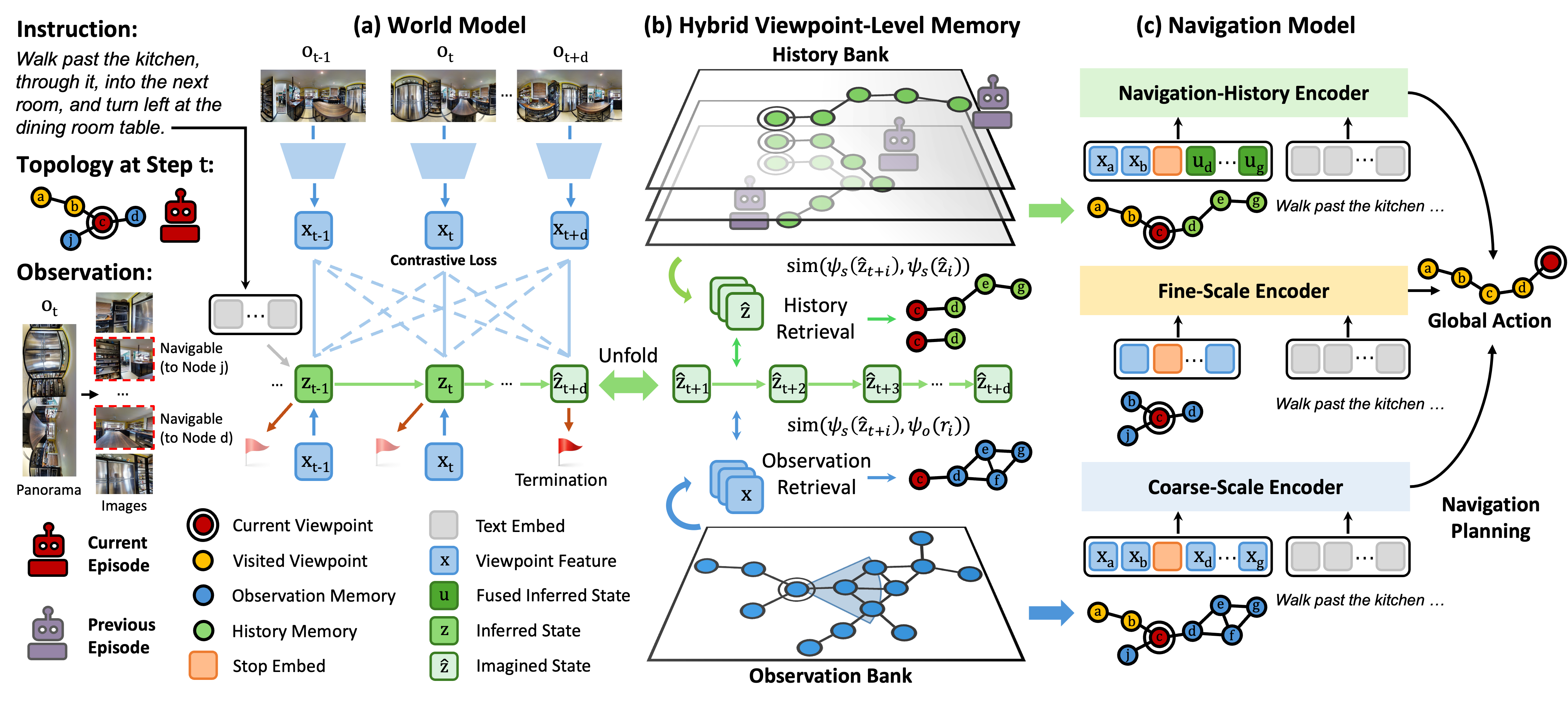
The world model, viewpoint-level memory, and navigation policy are trained together to turn imagination into selective, grounded recall.
A language-conditioned contrastive model unfolds latent future states from the current episode and instruction.
Imagined latents query a history bank for behavioural precedent and an observation bank for visual evidence.
Specialised encoders fuse coarse topology, fine visual detail, and retrieved navigation history into a single action.
Across ten scenarios in IR2R and GSA-R2R, Memoir navigates better while using memory more selectively. Replacing the query–retrieval pathway with ground truth reveals how much is still on the table.
IR2R validation unseen · SPL ↑ · bars scaled from 60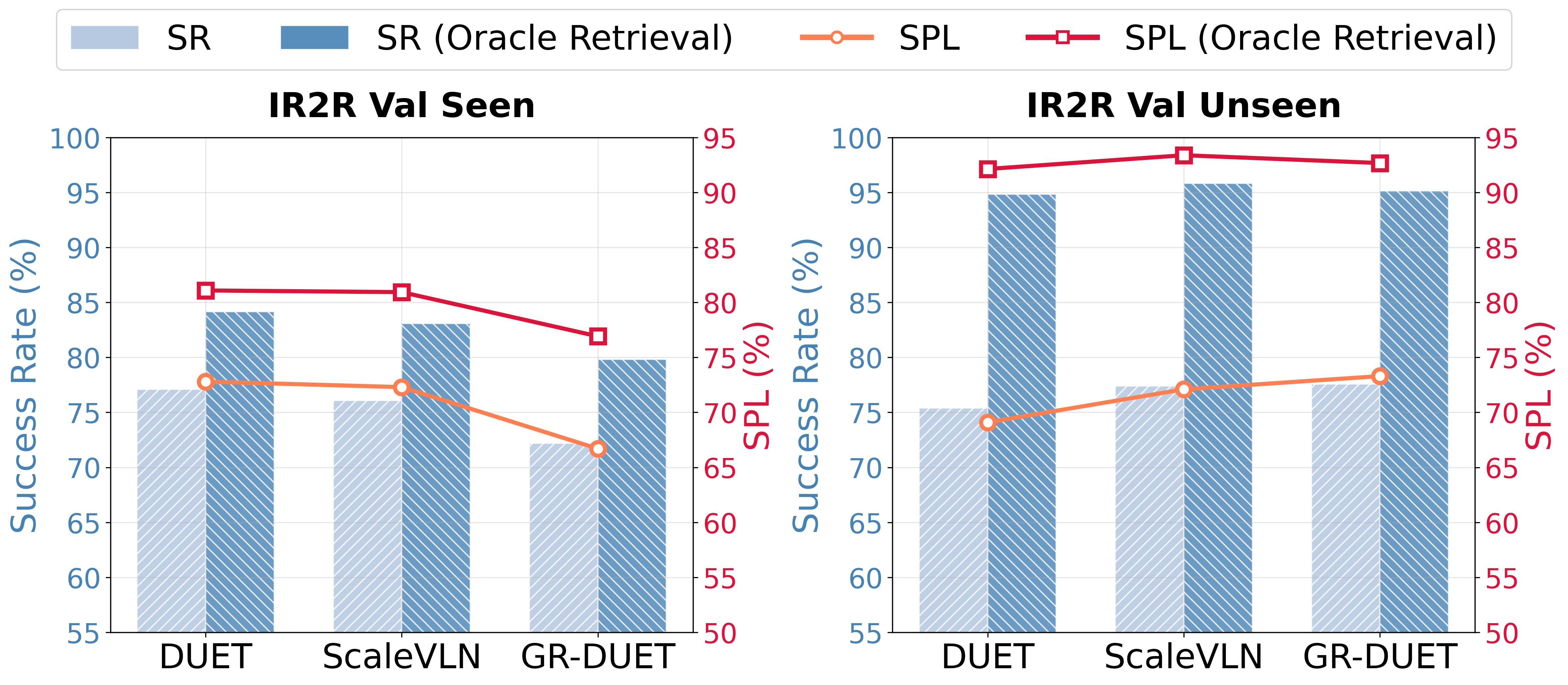
Memoir is an engineering testbed, not a biological model. But it makes a computationally precise proposal: prospective latent simulation can estimate which stored experience will be useful next.
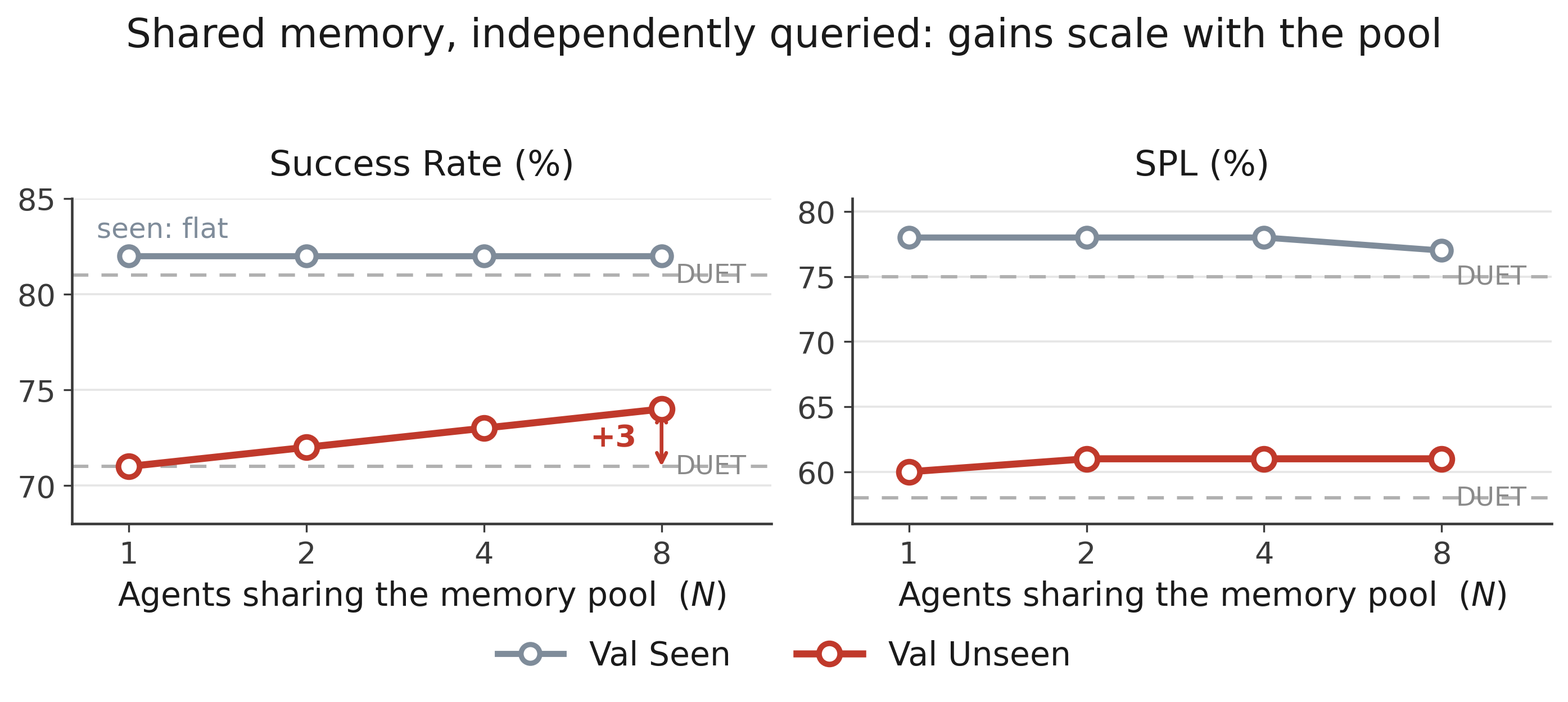
Prioritised replay weights memory access by expected future occupancy — the need term, computable from the successor representation over enumerable states under a fixed policy. Neither condition holds when observations are panoramic and the goal changes every episode. A goal-conditioned world model supplies the estimate instead.
Disrupting prospective simulation while preserving stored memory should degrade performance in proportion to the oracle gap; improving simulation fidelity should yield gains of the same magnitude.
Observing a demonstrator should move performance toward the oracle ceiling in proportion to the behavioural information the demonstration carries — a computational analogue for observationally biased replay.
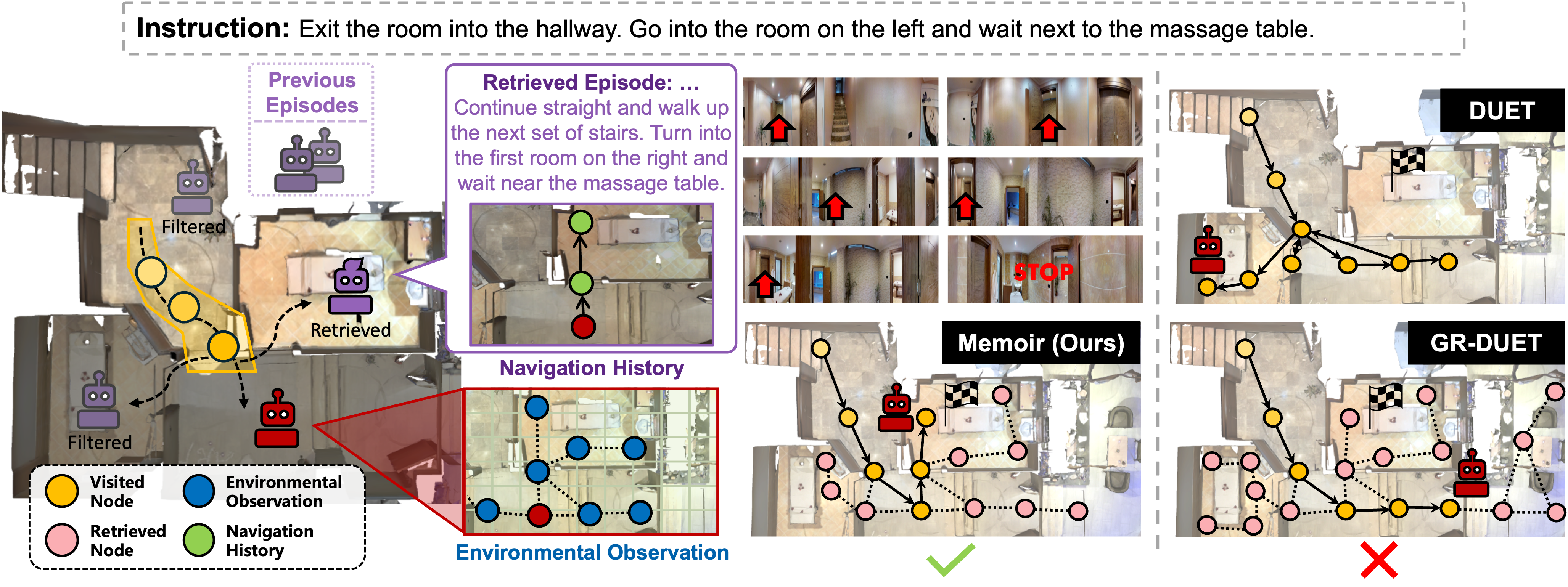
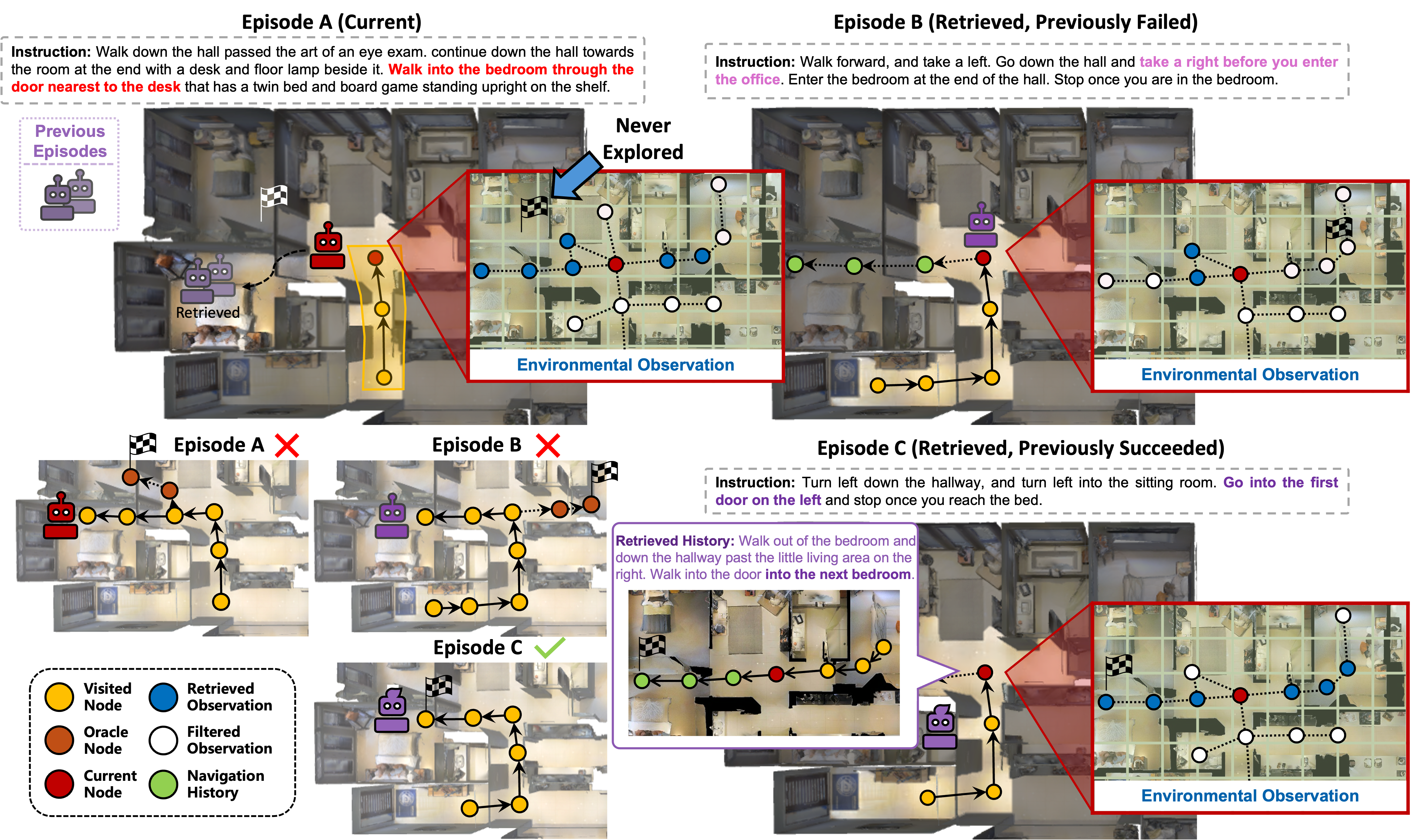
Memoir can recover from sparse observation by borrowing the route structure of a prior successful episode. But when a retrieved episode itself failed, its visual overlap can mislead the current policy. Behavioural outcome therefore matters, not just state similarity.
A memory system should remember not only where it has been, but whether what it did worked.
Explore the implementation, download the released datasets and checkpoints, or cite the TPAMI paper.
@article{xu2026dream,
  title   = {Dream to Recall: Imagination-Guided
             Experience Retrieval for Memory-Persistent
             Vision-and-Language Navigation},
  author  = {Xu, Yunzhe and Pan, Yiyuan and Liu, Zhe},
  journal = {IEEE TPAMI},
  year    = {2026}
}